There are only so many tokens that can pitch “passive rewards” to a numbers-obsessed degenerate before the overconfidence starts smelling suspicious and I begin drifting towards the next butthole launch out of pure self-defense.
After four straight days of living inside blockchain explorers, splitting hairs, splitting formulas, and very likely splitting my last remaining teaspoon of sanity, I can now say this confidently: SOL MINE’s reward distribution system is a real mechanical structure worth understanding.
And yes, I mean understanding, not just nodding along while somebody says “reflections,” “arbitrage,” and “utility” in a voice chat and hopes nobody follows up with anything more complicated than WEN MOON.
I had reservations early. A healthy amount, honestly. Too many launches throw around reward language and pray nobody opens Solscan sober. So naturally, I opened Solscan. Then I opened it again. Then the Telegram community joined in.
Then somehow it was past midnight, several of us were comparing wallet behavior like the sleepless ledger pickers we are, and I found myself discussing square roots with fellow nerds while my split ends and patience both deteriorated into the sad mess I am today.
This, by the way, is exactly why I enjoy our TG channel. Yes, occasionally it looks like a group of twelve-year-olds measuring imaginary epeens, but somewhere between the nonsense, people are actually digging into token mechanics together and when you get a room full of curious holders, beautiful things happen.
Under the hood, SOL MINE runs a two-stage reward system designed to keep SOL flowing to eligible holders even when market activity cools off. And yes, I checked the math because SOMEBODY had to. Preferably someone raised by Asian parents who instinctively distrust numbers until every decimal sits down, behaves, and accounts for itself :)
Every SOL MINE transaction carries a 3% tax. That means if the project sees $1,000,000 in trading volume, then $30,000 worth of value enters the tax system. That part’s simple enough: 3% of $1,000,000 = $30,000.
SOL MINE doesn’t stop there, though; that tax accumulates inside the project’s distribution wallet: AFq8TouWna4jYPUWFFBo3ftT2p6bSRVpzvgV4EBE5gor. This wallet acts like a reservoir. Taxed market activity routes a portion of each taxable transfer into the distribution wallet; then, every 24 hours, the mechanism performs its second move: Across observed cycles so far, the distribution wallet has been releasing roughly 10% of its balance per day into SOL, creating the reward pool.
This means that rewards are fed by two forces at once:
Active volume
Controlled reservoir release.
The reservoir only stays healthy if fresh taxed volume continues replacing what the daily release moves. In plain English, SOL MINE doesn’t rely entirely on today’s excitement to reward holders tomorrow, and the project’s still ticking even on quieter days!
Now I’m sure you’re asking, since I did- why does that 10% daily sell exist? Because without it, rewards would rise and fall entirely at the mercy of trading volume. On a high volume day, rewards will of course look healthy. On a quiet day? The Telegram channel looks like everybody’s Wi-Fi died and no one wants to make eye contact. That daily 10% release creates a steady, mechanical rhythm. Of course, this also means that the distribution wallet itself needs to stay healthy; so every day it sells, and every day volume helps refill what was spent. This is why watching the distribution wallet matters more in SOLM than just staring dramatically at charts and candles all day.
Currently, the minimum holding required to be eligible for daily rewards is 1,000,000 SOLM. That threshold exists for a reason though; at a very low market cap, tiny wallets could otherwise farm rewards cheaply, split across multiple addresses, harvest SOL, and liquidate constantly. We have all watched this nonsense happen elsewhere. Nobody needs another reward system feeding some determined little parasite hiding behind six wallets. So early on, SOL MINE keeps that gate high.
The plan is to lower eligibility to 100,000 SOLM at 1M market cap, once liquidity deepens and smaller holders can participate without destabilizing the reward stream. This early phase protects the structure; the later phase will expand access. Sensible progression. No interpretative dance required :D
Still here? Good, because the math gets even weirder. After dissecting actual distribution cycles, one pattern kept showing up that became impossible to ignore: holder payouts consistently align with square-root weighting rather than simple linear allocation! And yes, our Telegram descended gloriously into midnight math over this.
It matters a lot that rewards aren’t purely linear. If rewards were linear, a wallet with 10x more tokens than you would get 10x more reward. Whale-friendly enough, that’s why so many other developers default to it in their attempts to establish value. Just one straight no-ass-having line :/
SOLM rewards though? GURL. The observed payout curve bends like square-root weighing, which changes EVERYTHING.
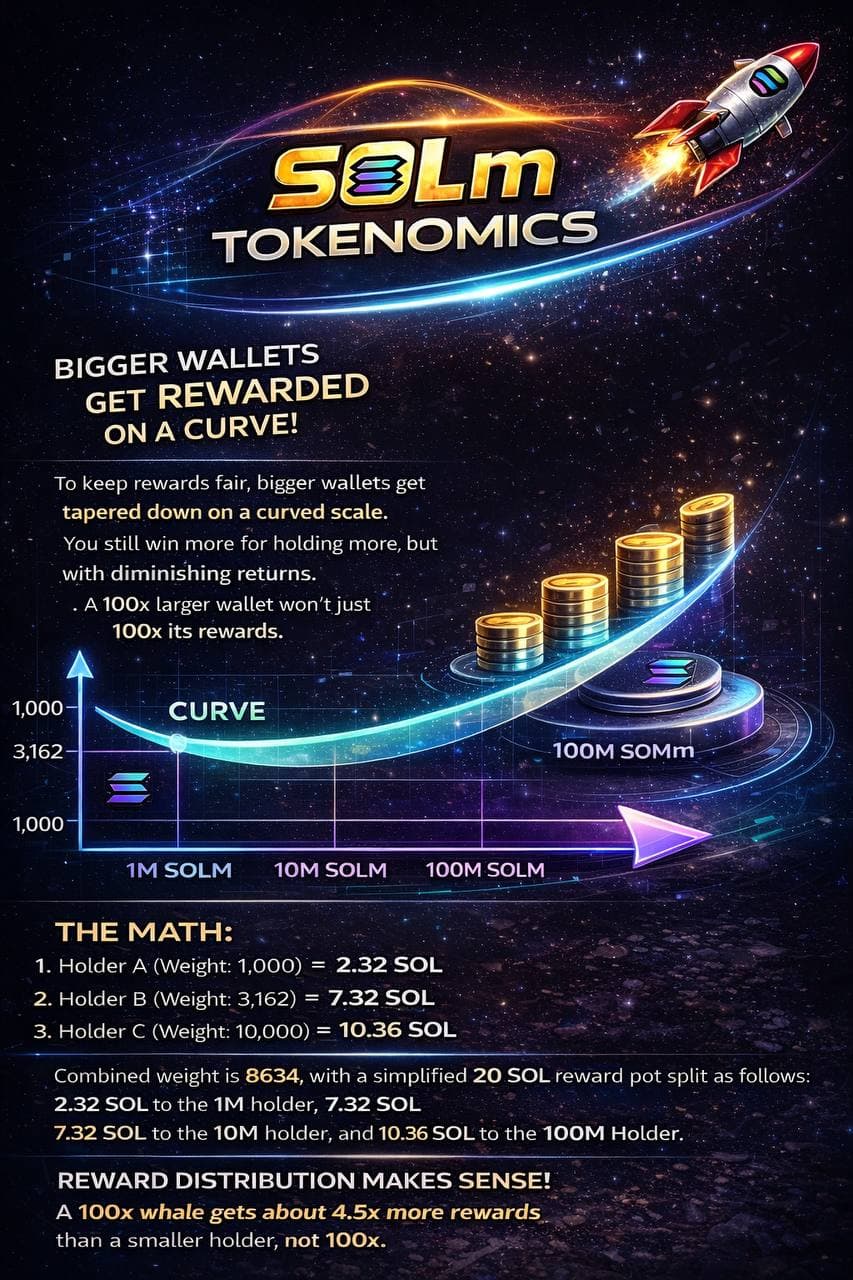
To make the curve visible without dragging everyone through raw wallet logs, let’s use a simplified 20 SOL example. Let’s look at three eligible holders and their weights.
1. 1M SOLM (Weight: 1000) 1000/8634 x 20 = 2.32 SOL
2. 10M SOLM (Weight: 3162) 3162/8634 x 20 = 7.32 SOL
3. 20M SOLM (Weight 4472) 4472/8634 x 20 = 10.36 SOL
Their combined total weight is 8634 and rewards split approximately 2.32 SOL to the 1M holder, 7.32 SOL to the 10M holder and 10.36 SOL to the 20M holder. The math says so, and multiple real distribution cycles point the same way. The blockchain says so. Feel another way about it?
Let's math it out:
Holder A: 1M SOLM (Square root: √1,000,000 = 1000)
Holder B: 10M SOLM (Square root: √10,000,000 = 3162)
Holder C: 100M SOLM (Square root: √100,000,000 = 10,000)
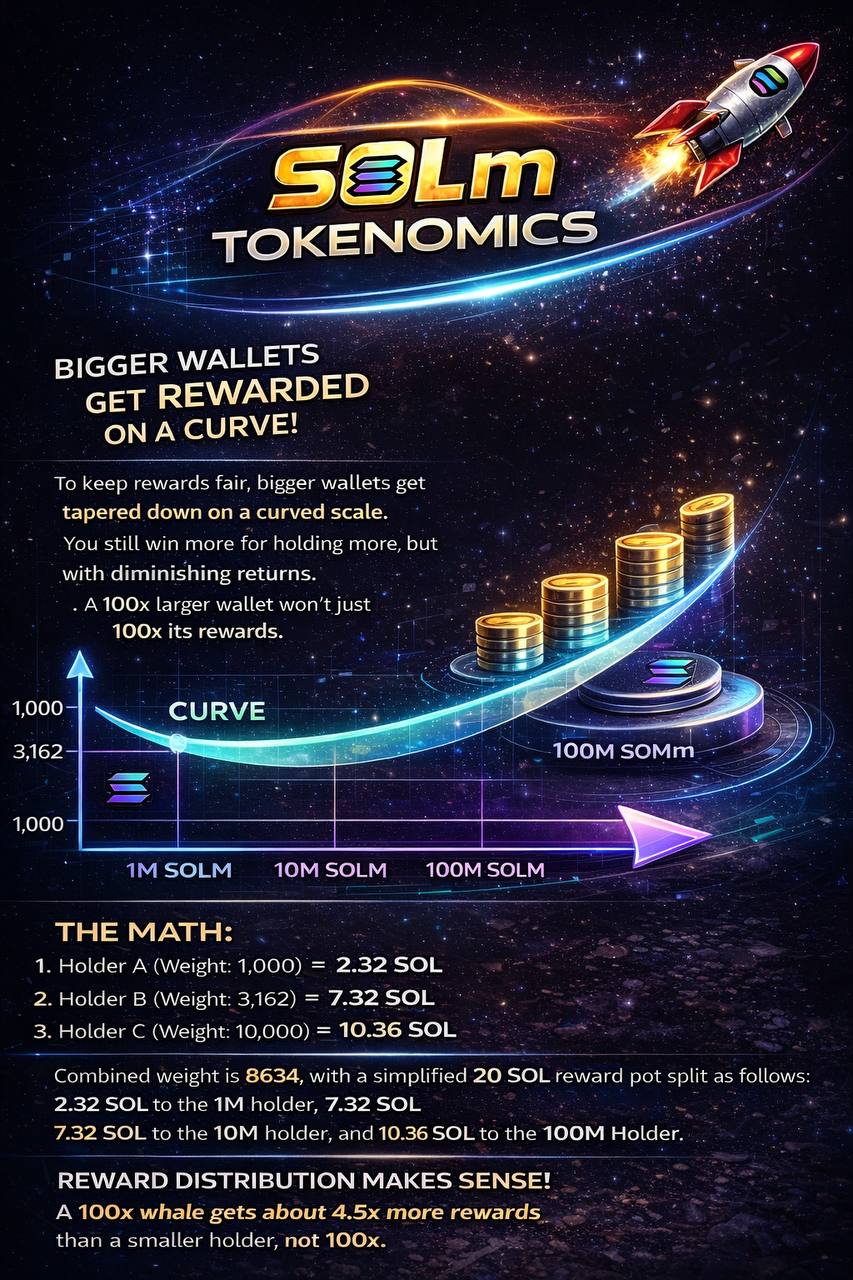
Notice what happened? Token ownership scales from 1 to 10 to 100, but reward weight scales from 1 to 3.16 to 10. This means that a whale still earns more, but not with absurd dominance. A 100x larger wallet isn’t just going to receive 100x the reward influence; it’ll get roughly 10x reward weight. That’s our curve bending and mathematically, it’s significant. One might say that is YUGE, especially for a smaller holder.
Because then minimum holders still matter and mid-holders still grow meaningfully. Whales still lead, but they’re no longer that uncomfortable gravitational singularity swallowing the room. This is healthier than many reflection systems where giant wallets quietly inhale everything while everyone else gets cute specks of dust.
Nevermind that I actually yelled that header out loud as I typed it. What makes SOL MINE unusual isn’t that it promises rewards, everybody’s mama’s token does that. They also promise dragons, and revolutions, and utility that keeps sending “soon” like that toxic ex with excellent timing and no intention of changing. Hi. It’s me. I’m also that toxic ex. Anyways.
What matters is that SOL MINE’s reward structure leaves visible fingerprints:
Tax enters the distribution wallet
Distribution wallet sells 10%
SOL moves outward to holders
Dev allocation reinforces liquidity (see for yourself)
When I say “trust me bro”, it’s because I followed this sequence directly on chain, just to verify that holders aren’t being asked to blindly trust slogans. You can inspect the machine yourself just like I did. Several of us did. Late. Very late. In crypto, this matters. Eventually, every project must survive the terrifying moment when somebody opens Solscan and starts asking intelligent questions.
Good tokenomics should satisfy two audiences: the degen who wants upside and the skeptical adult who asks, “fine. But where exactly does the money move?” SOL MINE gave a real answer to that question and naturally, that answer involved square roots. As any Asian plot twists eventually do.
